Roofing is one of the most common reasons homeowners and contractors rent a dumpster — and one of the most commonly mishandled. Old shingles are dense and heavy. A 2,000 square foot roof tear-off can produce 3 to 4 tons of debris before you've touched a single piece of decking.
Rent the wrong size and you'll either overflow the dumpster (triggering overfill fees) or pay for space you didn't need. This guide covers exactly what size dumpster you need for a roof replacement, what it should cost, and every mistake worth avoiding before the crew shows up.
How Much Debris Does a Roof Replacement Actually Produce?
The amount of roofing debris depends on three things: the square footage of your roof, how many layers of shingles are being torn off, and whether there's damaged decking that also needs to go.
As a general rule:
- One roofing square (100 sq ft) of asphalt shingles weighs approximately 250 to 400 pounds
- A single layer of shingles on a 2,000 sq ft roof produces roughly 2 to 3 tons of debris
- Two layers of shingles on the same roof produces 4 to 6 tons
- Adding plywood decking replacement adds another 1,500 to 2,000 lbs per 1,000 sq ft
This is why weight limits matter more for roofing than almost any other dumpster rental use case. Shingles are one of the heaviest debris types you can throw in a roll-off container. Always confirm the weight allowance before booking — not just the cubic yardage.
What Size Dumpster Do I Need for a Roof Replacement?
Here is the straightforward answer for the most common roof sizes:
| Roof Size | Layers Being Removed | Recommended Dumpster Size | Estimated Weight |
|---|---|---|---|
| Under 1,500 sq ft | 1 layer | 10 yard | 1.5 – 2 tons |
| 1,500 – 2,500 sq ft | 1 layer | 20 yard | 2 – 3.5 tons |
| 1,500 – 2,500 sq ft | 2 layers | 30 yard | 4 – 6 tons |
| 2,500 – 4,000 sq ft | 1 layer | 30 yard | 3.5 – 5 tons |
| 2,500 – 4,000 sq ft | 2+ layers | 40 yard | 6 – 9 tons |
| Commercial / 4,000+ sq ft | Any | 40 yard (multiple if needed) | 8 tons+ |
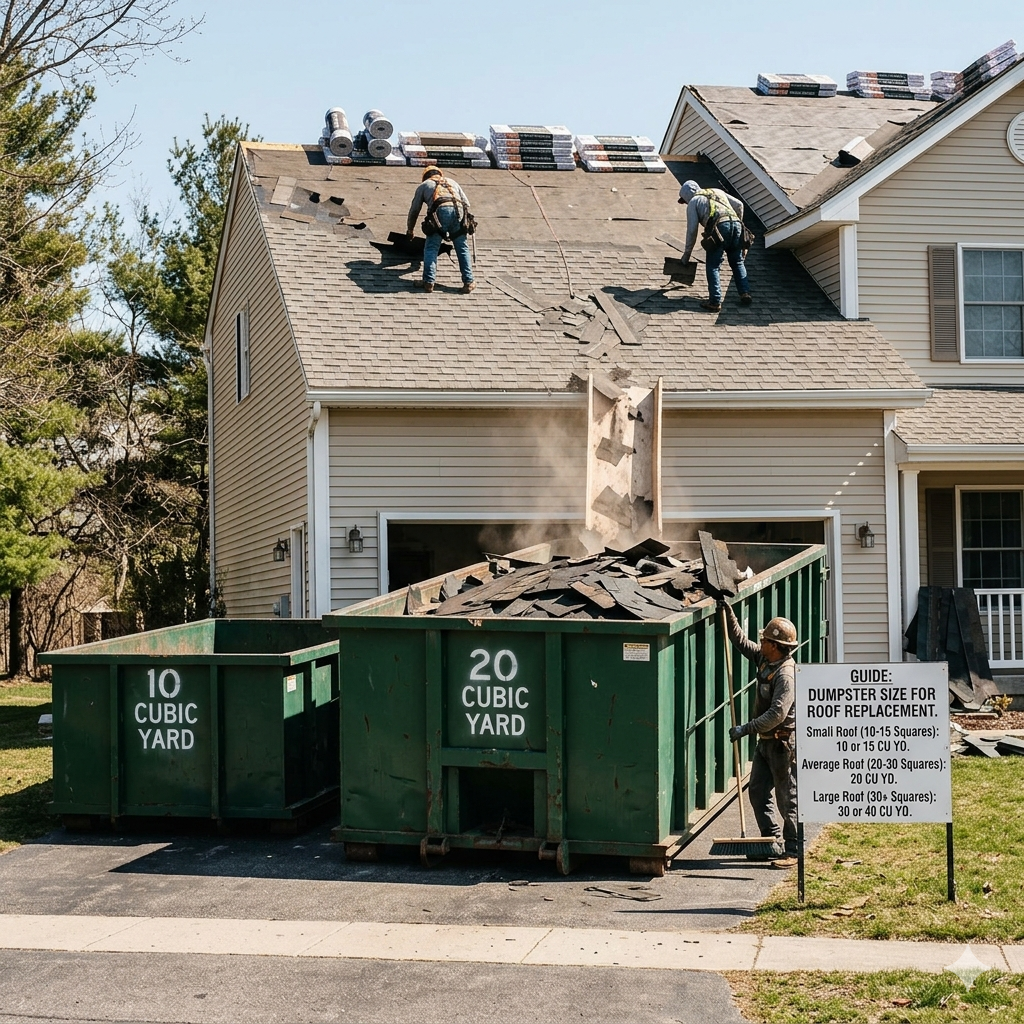
Quick rule of thumb: If your roof is under 2,000 square feet and you're only removing one layer of shingles, a 20 yard dumpster almost always does the job. If there are two layers, or if you're also replacing decking, go to a 30 yard — the extra cost is far less than an overage fee.
10 Yard Dumpster for Roofing — When It Works and When It Doesn't
A 10 yard dumpster can work for very small roofing jobs: a garage roof, a small shed, or a single-layer tear-off on a home under 1,200 square feet. The problem is the weight limit — most 10 yard containers cap out at 2 tons. Asphalt shingles are extremely heavy, and it's easy to hit that limit with a relatively small footprint of roofing.
If your roofing contractor is pushing you toward a 10 yard to keep your costs down, ask them specifically what the debris weight will be before agreeing. The overage fee for exceeding the weight limit — typically $75 to $100 per ton — can quickly outpace the price difference between a 10 and 20 yard dumpster.
20 Yard Dumpster for Roofing — The Most Common Choice
For the majority of residential roof replacements in the United States, a 20 yard dumpster is the right answer. It holds approximately 4 tons of roofing debris, which covers a single-layer tear-off on most homes between 1,500 and 2,500 square feet.
The 20 yard is also the easiest to place. It fits in most driveways without blocking the road and doesn't require the longer delivery truck that 30 and 40 yard containers need. For most homeowners scheduling a standard residential re-roof, this is the call.
30 Yard Dumpster for Roofing — Two Layers or a Larger Home
If your roof has two layers of shingles being torn off — which is common on homes that skipped a full tear-off the last time around — the debris weight roughly doubles. A 30 yard dumpster with a 6-ton weight allowance is the safe choice here.
The 30 yard is also appropriate for larger homes in the 2,500 to 3,500 square foot range, even with a single shingle layer, if decking replacement is part of the scope. Old plywood adds significant weight even though it looks like a manageable volume.
40 Yard Dumpster for Roofing — Commercial and Large Residential
The 40 yard is primarily a commercial roofing dumpster. It's appropriate for flat commercial roofs, large multi-family residential properties, or any job where the shingle debris alone will exceed 6 tons. Most roofing contractors working commercial jobs order the 40 yard as a default and request a swap-out if the job runs longer than expected.
For standard single-family homes, the 40 yard is usually overkill — and harder to position in a residential driveway given its length (typically 22 feet).
How Much Does a Dumpster Rental Cost for a Roof Replacement?
Roofing dumpster rental pricing follows the same structure as any dumpster rental, but weight matters more here than in most other use cases. Here are realistic ranges for 2026:
| Dumpster Size | Weight Allowance | Typical Price Range | Best For |
|---|---|---|---|
| 10 yard | 2 tons | $299 – $399 | Small garage/shed roof |
| 20 yard | 4 tons | $399 – $499 | Standard residential re-roof (1 layer) |
| 30 yard | 6 tons | $499 – $599 | Two-layer tear-off or larger home |
| 40 yard | 8 tons | $599 – $749 | Commercial roofing, large homes |
Prices vary by city and market. In competitive metro areas you may find lower pricing due to competition between providers. In smaller markets, prices can run slightly higher. Check current service area pricing for exact quotes in your area.
The Weight Limit Problem — Why Roofing Is Different
Most homeowners renting a dumpster for a garage cleanout or furniture removal never think about weight limits. With roofing, weight limits are the most important variable in your rental decision.
Asphalt shingles are one of the densest debris types that go into roll-off containers. A standard bundle of three-tab asphalt shingles weighs 60 to 80 pounds. A roofing square (100 sq ft) typically requires three bundles — meaning 180 to 240 pounds per roofing square, before you factor in the old underlayment, nails, and any damaged decking.
The calculation matters: a 2,000 sq ft home has 20 roofing squares. At 240 lbs per square, that's 4,800 lbs of shingles alone — nearly 2.5 tons just from the shingle layer. Add underlayment and nails, and you're approaching the limit of a standard 10 yard container before the decking is even considered.
Always ask your dumpster company: "What is the weight limit and what is the per-ton overage fee?" These numbers should be disclosed before you book.
Can You Mix Other Roofing Debris with Shingles?
Yes — and most homeowners do. A typical roofing dumpster will contain old shingles, underlayment felt, roofing nails, damaged plywood decking, fascia boards, flashing, and gutters if those are also being replaced.
What you cannot mix in are hazardous materials. Roofing projects occasionally uncover older materials that require special handling:
- Asbestos-containing shingles — Homes built before 1980 may have asbestos-containing roofing materials. If you suspect this, do not throw them in a standard dumpster. Have a licensed abatement contractor test the material first.
- Tar or pitch roofing on flat roofs — Some tar-based flat roofing materials are considered hazardous. Check with your rental company before assuming they're acceptable.
- Lead flashing — Older homes sometimes have lead flashing around chimneys and skylights. This requires separate disposal.
For standard composition shingles installed in the last 30 years, you have nothing to worry about — they go straight in the dumpster.
Do You Need a Permit for a Roofing Dumpster?
The permit question for a roofing dumpster is the same as any dumpster rental: you need a permit only if the container goes on a public street or city right-of-way. Driveway placement — which works for the vast majority of residential roofing projects — requires no permit in almost every U.S. city.
The one exception worth planning for: if your home doesn't have a driveway and the dumpster must go on the street, check with your city's public works department before delivery day. In most cities this is a $25 to $75 permit and takes 24 to 48 hours to process.
For specific permit guidance in our primary service areas, review your local city public works requirements and contact us through our service areas page for location-specific help.
Can I Rent a Dumpster Directly Instead of Through My Roofer?
Yes — and in many cases you'll pay less by renting directly than going through your roofing contractor.
Many roofing contractors include dumpster rental as a line item in their estimate and mark it up 20 to 40 percent. This is standard industry practice and not unethical — but it means you have the option to arrange your own dumpster rental and ask your contractor to deduct the dumpster line item from their bid.
The tradeoff: your contractor may be used to coordinating delivery timing themselves, and taking that off their plate adds a coordination step for you. For most straightforward residential re-roofs, the logistics are simple enough that renting directly makes sense. For large commercial jobs with tight scheduling, letting the contractor handle it may be worth the markup.
If you rent directly, give your roofing crew at least 24 hours' advance notice of the dumpster's arrival so they can plan their start time accordingly. Same-day delivery is available in many service areas if your schedule changes last minute.
5 Mistakes to Avoid When Renting a Dumpster for Roofing
1. Underestimating the weight
The most common and costly mistake. Two layers of shingles on a 2,500 sq ft roof will almost certainly exceed the weight limit on a 20 yard container. When in doubt, size up or ask your contractor exactly how many layers are coming off.
2. Not confirming where the dumpster will go before delivery day
The driver drops the container where you tell them — and moving it afterward requires a second truck visit. Walk your driveway before delivery and decide exactly where you want it. Make sure it's not under low-hanging power lines and doesn't block your roofing crew's access to the roofline.
3. Booking too far in advance without confirming
Most roofing projects get delayed by weather. If you've booked a dumpster for Tuesday and the crew doesn't start until Thursday, you're either paying for two extra days you don't need or scrambling to reschedule. Book for the morning of the first tear-off day, not in advance.
4. Throwing in prohibited materials
Lead flashing, old tar-based flat roofing, and any material you suspect may contain asbestos should not go in a standard dumpster. The disposal fee and potential fine for hazardous materials far exceeds the cost of proper removal.
5. Forgetting to ask about overfill policies
Most companies charge a flat fee if debris extends above the fill line of the container, separate from the per-ton overage fee. Ask both questions: "What's the overfill policy?" and "What's the per-ton overage charge?" before you book.
How to Get the Best Price on a Roofing Dumpster Rental
A few practical tips for getting the lowest price without sacrificing service:
- Call directly, don't just use the web form. Rental companies often have flexibility on pricing that isn't reflected online. A five-minute phone call frequently gets you a better rate.
- Book for the exact number of days you need. If the job is a one-day tear-off, tell them. Many companies will do a single-day rental at a reduced rate rather than charging a full 7-day period.
- Ask if shingles-only loads qualify for a flat-rate price. Some companies offer a lower rate for dumpsters going exclusively to a shingle recycling facility, since they're more straightforward to process.
- Avoid Fridays for delivery if your project starts on a weekend. Weekend rentals on short timelines sometimes carry a delivery surcharge. Scheduling for early in the week gives you more flexibility.
Frequently Asked Questions: Roofing Dumpster Rental
How many bundles of shingles fit in a 20 yard dumpster?
Roughly 125 to 175 bundles of standard three-tab asphalt shingles fit in a 20 yard dumpster before hitting the weight limit. This equates to approximately 40 to 55 roofing squares — enough for a standard single-layer residential re-roof under 2,500 square feet.
Can I put roofing shingles in a regular dumpster?
Yes. Standard asphalt, fiberglass, and composition shingles are accepted in most roll-off dumpsters. The key constraint is weight, not volume. Always confirm the weight allowance matches the estimated tonnage of your tear-off before booking.
How long does a roofing dumpster rental last?
Most residential roofing projects are completed in one to three days, and a standard 7-day rental period gives plenty of buffer. If your project runs longer — common for larger homes or jobs that discover unexpected decking damage — rental extensions are available at a daily rate.
What happens if my dumpster gets too heavy from shingles?
The driver will weigh the container at the facility. If it exceeds the included weight allowance, you'll be charged an overage fee — typically $75 to $100 per ton over the limit. The best way to avoid this is to accurately estimate the number of layers and square footage before booking and match that to the right dumpster size and weight tier.
Do roofing contractors usually include dumpster rental?
Many do, but not all. Always check your contractor's itemized estimate. If dumpster rental is included, ask what size and company they're using — you have the right to arrange your own if you can get a better price.
Ready to Rent a Dumpster for Your Roofing Project?
Whether you're a homeowner managing a single-family re-roof or a roofing contractor scheduling multiple jobs, Rapid Dumpster Rental makes the logistics simple. Same-day delivery is available in most of our active service areas listed on our services page.
Call us before the crew shows up and we'll help you choose the right size, confirm the weight allowance matches your project, and get the container placed exactly where you need it — before the first shingle hits the ground.